Best App to Split A Car Payment: Shared or Across Paychecks
Find the best app to split car payments between people or across paychecks. Compare flexible ways to manage payments and stay on budget.

“Hey, did you send me your half yet?” If your name is on the car loan, you've probably typed that text more than once.
When the other half shows up late, the lender still takes the full payment from your account. If it can't, the missed payment lands on your credit report.
Or maybe nobody else is involved. The car is yours alone, and the payment leaves your account two days before your paycheck arrives. People search "split car payment" for both reasons.
The best app to split a car payment depends on which one you're dealing with. For two people sharing a car, we built Pool to hold both shares before the lender pulls a dollar. A Pool can also spread a single payment across your paychecks and we'll show when a paid app makes more sense.
Which Car Payment Split Do You Need?
| Your situation | What you need | Where to look |
|---|---|---|
| You and someone else share the car and the payment | Both shares in one place before the due date | A Pool, so the payment is made from money set aside for that purpose |
| The car is yours and you need to set aside money from multiple paychecks to cover the full payment before it’s due | Smaller amounts set aside from each paycheck | A Pool with recurring deposits timed around your paydays. The full payment needs to be available before your lender pulls it, so allow time for deposits to clear. |
| Both. You share the car and money is tight | An account that handles both: each person's share, deposited on their own paydays | One Pool for both shares. Then ask your lender about changing your payment date or splitting it into two dates. |
Key Takeaways
- A Pool is the cleanest way to split a car payment between two people. You each pay your share into the Pool and you can make your payment with the Pool's own account and routing numbers.
- Paycheck-splitting apps charge real money. Split Pay adds $9.99 plus 1.5% of the payment. On a $500 car note that's $17.49 a month, or $209.88 a year for the same car.
- Your lender may already split the payment. Upstart, for example, lets borrowers whose account is current switch AutoPay to twice a month, with no app in the middle.
- Every two weeks isn't the same as twice a month. Paying every two weeks adds up to 13 monthly payments a year instead of 12, which can shorten the loan if your lender puts the extra toward principal.
- A Pool lets you set aside part of each paycheck for your car payment. The full amount needs to be available before your lender pulls the payment, so allow time for deposits to clear. If your paychecks won’t cover the first payment in time, you’ll need enough money set aside to cover that gap. Pool doesn’t advance missing funds.
The Best App to Split a Car Payment Between Two People
This version comes up when the car belongs to more than one person. It might be a couple, two siblings, a parent and their young driver, or roommates who share one car and one insurance bill.
No paycheck-splitting app helps here, because each one only moves money out of your own account. Both shares need to land somewhere before the lender takes the payment.
1. Pool
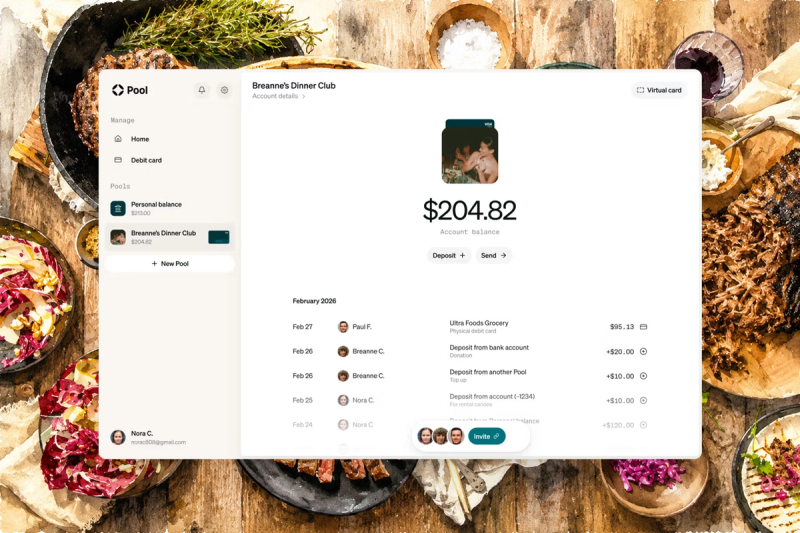
A Pool is a financial account with its own purpose and you can add another member. For a shared car, the purpose is the payment, so the money for it never sits in one person's checking account.
You each pay your share into the Pool before the due date. Recurring deposits can also top the Pool up on a schedule. Make sure to schedule deposits early enough to become available before the payment is due.
Every Pool has its own account and routing numbers, so you can add it in your lender's portal like any other funding source. The car payment then leaves from a balance that's already full.
Gas and insurance can be paid right from the Pool too, since each member gets a free Visa debit card that works with any Pool where they're a Spender or Admin.
Whoever sets up the Pool invites members and assigns each one a role. Admins have the same capabilities as the Owner. A Spender can add money, move it out, and spend with a debit card. A Viewer can only view members and transactions.
Every transaction shows up in the activity feed, so neither of you has to ask whether this month's payment went through. We've managed more than 125,000 Pools so far, a number we also publish in our guide to pooling.
Starting a Pool, inviting people, funding it, and using virtual and physical debit cards are all free. We only charge a clearly labeled fee on opt-in transactions such as Instant Transfers.
Right for you if: you share a car payment with someone month after month and want the money in one place instead of moving between two accounts.
Skip it if: you need an app to advance money for the payment. A Pool only pays with money you’ve already deposited and that’s available to spend.
Every member also verifies their identity when they join, so set the Pool up before the next bill rather than the night it's due.
The Usual Workarounds for a Shared Car Payment
| The workaround | Why people use it | The catch |
|---|---|---|
| One person pays, the other sends their half | Nothing to set up | That person's account carries the full payment until the transfer lands |
| A payment app request each month | The app is already on both phones | Requests get ignored, and the record sits in a chat thread |
| A tracking app like Splitwise | It keeps the math honest | It records the debt without pooling the funds to be ready for the payment |
They all work until the month somebody forgets. A late auto loan payment reaches the credit report of whoever signed the loan, which leaves the person on the paperwork covering the gap.
How to Split a Car Payment With Someone Else
Name the Pool after the car, something like “Civic payment” and invite whoever shares it. Anyone who drives it should be a Spender or Admin and anyone who only needs to see the balance can be a Viewer.
Agree on the split before the first payment and put it in writing. Half and half is common, and so is a share based on who drives the car most.
Fund it a few days early. Set up recurring deposits so each share arrives on its own.
Then add the Pool's account and routing numbers in your lender's portal as the payment account. Keep a small cushion in the balance so a slow transfer never turns into a late payment.
The same Pool can carry the rest of the car's costs, like fuel for a road trip or the insurance bill, paid with the debit card at the pump or online.
Splitting One Car Payment Across Two Paychecks
If the car is yours alone, you can set aside the payment in smaller pieces around your paydays. With a Pool, the lender still gets the full payment on the usual schedule, so the money needs to be ready in time.
2. Pool With Recurring Deposits
A Pool isn’t only for payments shared between people. If the car is yours alone, set up weekly recurring deposits or two monthly recurring deposits into a car Pool, timed around your paydays. Then add the Pool as the payment account in your lender’s portal.
Each deposit covers part of the next payment. Plan the amounts and dates so the full amount is available before the lender pulls it, allowing time for deposits to clear. Recurring deposits are free.
The first month depends on timing. If your deposits clear before the lender pulls the full payment, no extra starting balance is needed. If they won’t, you’ll need enough money already set aside to cover the gap. Pool doesn’t advance missing funds.
Weekly deposits of a quarter of the payment add up to 13 payments a year instead of 12, so the extra builds a cushion for a thin month.
Right for you if: you can have the full payment ready in your Pool before the lender pulls it and want to avoid a monthly splitting fee.
Skip it if: your deposits won’t clear in time and you can’t cover the gap. Ask your lender about changing the payment schedule before paying for an app that advances the money.
3. Split Pay
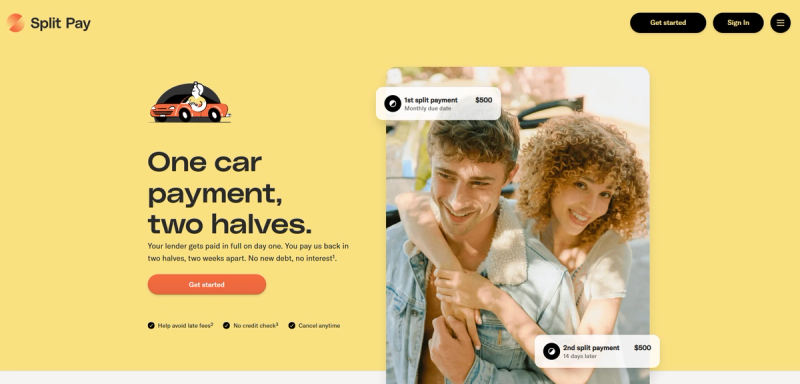
Split Pay is built for exactly this. It pays your full car payment to the lender on the due date, then collects from you in two parts, two weeks apart.
Your lender sees one on-time payment for the full amount. Split Pay says the loan terms don't move, so your rate and payoff date stay where they were.
Approval runs on cash flow instead of your credit score. Split Pay reads your income and spending through Plaid, skips the credit check, and sets your second payment anywhere from 30% to 50% of the bill.
The fee is where it stops being cheap. Split Pay charges $9.99 plus 1.5% of the total payment, added to your first payment.
Right for you if: you can’t fund the full payment in time and your lender won’t change the payment schedule.
Skip it if: you'd rather not pay extra for the same car every month. The fee repeats with each payment, and your balance and rate stay exactly where they were.
What Split Pay's Fee Costs Over a Year
The 1.5% is the part that grows with your payment. Here's the same fee on three common car payments.
| Your monthly payment | Split Pay fee | Cost per year |
|---|---|---|
| $350 | $15.24 | $182.88 |
| $500 | $17.49 | $209.88 |
| $700 | $20.49 | $245.88 |
On the $500 loan, a year of splitting costs $209.88, close to half of one monthly payment. The fee sits on a bill you already have, so the car quietly costs more every month you use it.
Ask Your Lender Before You Pay Anyone
Some auto lenders already let you split the payment through their own portal. Upstart, for one, offers twice-monthly AutoPay to borrowers whose account is current.
The wording matters more than it looks. Twice a month means 24 half payments a year, which equals 12 monthly payments.
Every two weeks means 26 half payments, which works out to 13. That extra payment can shorten the loan, as long as your lender applies it to principal.
Four questions get you a straight answer from your lender.
- Can I pay half now and half in two weeks without a fee?
- How do you apply a partial payment? Some lenders hold it until the full amount arrives.
- Does an extra payment go to principal, or does it just cover next month?
- Can I move my due date closer to payday instead?
If the answers are yes, you've fixed the timing without paying anyone. If they're no, a paycheck-splitting app is doing something your lender won't.
Choosing an App to Split a Car Payment by Situation
| Your situation | Best option | Why |
|---|---|---|
| You share the car and the payment with someone The car is yours and you can fund the full payment before it’s due | Pool A Pool with recurring deposits | Both shares land in one account before the payment Set aside money from each paycheck, allowing time for the full amount to clear before the lender pulls it |
| The car is yours, and you can’t fund the full payment before it’s due | Your lender | Ask about twice-monthly payments or a new due date before paying for an app |
| You can’t fund the payment in time, and your lender won’t change the schedule | Split Pay | It fixes the timing for $9.99 plus 1.5% of each payment |
| You want the loan paid off sooner | Your lender, every two weeks | 26 half payments a year add up to 13 monthly ones |
| You only need a record of who owes what | A tracking app like Splitwise | It keeps a record when no money needs to move |
The same setup works for any bill two people pay every month, from insurance to a phone plan. You can run a separate Pool for household bills next to the one for the car.
FAQs About Splitting a Car Payment
What Is the Best App to Split a Car Payment?
It depends on what you're splitting. If two people share the car, we at Pool built our accounts for exactly that, since both shares land in one Pool before the due date and the payment leaves from there.
If the car is yours alone, a Pool with recurring deposits lets you set aside part of each paycheck for your car payment. The full amount needs to be available before the lender pulls it, allowing time for deposits to clear. You only need an upfront cushion if those deposits won’t cover the payment in time. Otherwise, Split Pay fronts the payment for $9.99 plus 1.5% each time.
How Do You Split a Car Payment Between Two People?
Open a Pool for the car, invite the other person, and agree on each share and its timing. You both fund it before the due date, and the lender pulls the payment through the Pool's account and routing numbers.
Can You Split a Car Payment Without an App?
Yes, if your lender allows it. Ask to move your due date closer to payday or to pay twice a month. Upstart, for example, offers twice-monthly AutoPay to borrowers whose account is current.
Do Apps to Split Car Payments Affect Your Credit?
Split Pay approves on cash flow through Plaid instead of a credit check. Your lender still records one on-time payment. A missed loan payment is different, since it reaches the credit report of whoever signed the loan.
Is Splitting a Car Payment a Loan?
Split Pay says it doesn't charge interest. It pays your lender and you repay in two parts plus a fee. With a Pool, nobody lends you anything, because the money already belongs to you and the other member before it leaves.
What Happens If the Other Person Doesn't Pay Their Half?
The lender still expects the full amount from whoever signed the loan. A Pool shows the gap days early in the balance and the activity feed, which gives you time to cover it or talk it through.
Can Two People Be on One Car Loan?
Yes. A co-signed or joint auto loan is arranged with the lender, and both people are responsible for the full amount. A Pool handles the money either way, whether both names are on the loan or only one is.
Is Pool a Bank?
No. Pool is a financial technology company, not a bank. Banking services are provided by First Internet Bank, Member FDIC, and the Pool Visa debit card is issued by First Internet Bank.
Give the Car Payment Its Own Account
A shared car is easier when the money for it sits where both of you can see it, instead of in one person's checking account with a reminder attached.